
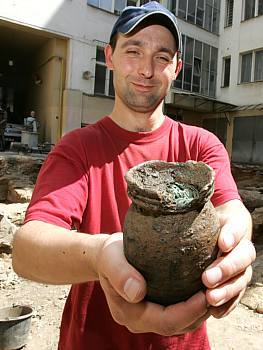
 Archaeologists have discovered a ceramic vessel full of silver coins in the center of Prague. The money was minted in Kutná Hora in the mid-15th century. Similar discoveries in Prague are rare, informed Vojtěch Kašpar from the archaeological company Archaia.
The so-called Loštice cup was hidden under the floor of a stone Gothic house. Its foundations were discovered by archaeologists under the asphalt surface of a courtyard between Štěpánská and Školská streets. The ceramic vessel contained 700 to 1000 silver coins weighing about 0.4 grams each. The circular coins without an inscription bear the image of the Czech lion. "These coins were minted in Kutná Hora during the period when traditional Prague groschen were not being produced there," explained Kašpar. At that time, a groschen was worth seven of these circular coins.
"The value of the find at the time of its deposit represented a fortune, for which it was possible to buy roughly three cows at the cattle market, on today's Charles Square," calculated the archaeologist. According to Zdeněk Dragoun from the National Heritage Institute, it was definitely a significant sum at the time. For comparison, a similarly wealthy person today could afford to buy a car, according to him.
The current value of the hoard is not great, according to Kašpar. A coin can be bought at auctions for 20 to 60 crowns, depending on its condition. "However, the historical value is priceless," he noted.
The coins are now in the care of conservators, who are X-raying them. Afterwards, the coins will be gradually washed out of the vessel. "The conservation and documentation of the coins will take several months," said Kašpar. According to him, it will cost hundreds of thousands of crowns. "The rescue of the hoard will cost much more than its monetary value," noted the archaeologist.
According to him, his colleagues also found in the courtyard a number of other pieces of evidence of settlement from the 13th century to the present. For example, a modern-era well concealed a multitude of items from the time when the writer Jaroslav Hašek grew up in the neighboring house. "These include a chamber pot, a half-liter mug, bottles, a flask, and a wooden bowling ball," listed the archaeologist. Experts are examining the space between the houses because the construction of a new hotel is planned there.


