
 Zdeněk Nechanický
The existence of the oldest and rarest Russian coins, called by contemporaries after the metals from which they were minted zlatniks and srebreniks, was unknown until the end of the 18th century. The first specimen, a srebrenik of Prince Yaroslav (1019 - 1054), was discovered in 1792 in Kyiv by a certain collector among church pendants on an icon. Coins of a similar type were also minted in gold and are called zlatniks. The first zlatnik of Prince Vladimir (980 - 1015) was also found in Kyiv in 1796. It was owned by a Ukrainian soldier who had received it from his mother1). These coins became better known after the uncovering of a hoard of 10th-century Byzantine gold coins in 1804 in Pinsk. Among them were several zlatniks of Prince Vladimir (no other ruler minted zlatniks). In the 1820s, several more srebreniks appeared, which were initially considered Byzantine. In the following decades, these then mysterious coins sparked a series of disputes about their origin. Historians of the time dealing with numismatics leaned towards the opinion that they were issues of Bulgarian or Serbian tsars. The models for zlatniks and srebreniks were Byzantine coins, but with their primitive execution (we can also use the term "barbarization") they are indeed very similar to the oldest Bulgarian coins.
In 1852, the largest hoard to date of about 200 srebreniks (the Nezhinsky hoard) was uncovered, which refuted the prevailing views on the origin of these coins. With further finds in the 2nd half of the 19th century, sufficient study material was obtained, which allowed the deciphering of the very difficult-to-read inscriptions. Spassky describes the difficulty of identifying and attributing zlatniks and srebreniks of Kievan Rus'. He believes that the shallowly struck or often incomplete coins were minted with bronze dies, which were moreover frequently re-engraved (retaining fragments of the original image)2). The minting technique is the cause of many variants. Many inscriptions have not been deciphered to this day.
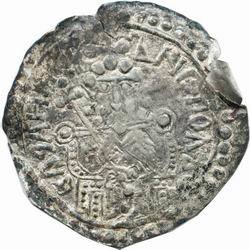
These coins were in their time proof of the existence and sovereignty of the Eastern Slavic state. Despite undeniable traces of 10th-century Byzantine models, these oldest Russian coins bear Slavic inscriptions with the names of princes and their primitive portraits on the obverse. The reverse of srebreniks features the dynastic emblem of the princes – the Rurikid trident (the current Ukrainian Republic uses it as its state emblem). At the same time, these coins are the oldest Russian written monuments.
On the obverses of srebreniks we most often see a prince on a throne (prestol, stol) with an inscription in Old Slavonic script: VLADIMIR NA STOLE. On the reverse, around the trident, is the inscription A SE EGO SEREBRO. On the reverses of zlatniks, Jesus Christ is depicted (similar to contemporary Byzantine coins) with the letters IC XC (Jesus Christos)3). Coins are known with the names of only three rulers: Vladimir (980 - 1015), Sviatopolk (1015 - 1019), and Yaroslav (1019 - 1054). The first two minted their coins in Kyiv, Vladimir from 988 to 1015 and Sviatopolk in 1018. Yaroslav minted in the first years of his reign in Novgorod. His srebreniks are the rarest, only 11 specimens have survived. There exist forgeries of them, made in Scandinavia. Similar srebreniks were also minted around 1070 by the Tmutorokan prince Oleg-Mikhail4).
In Kievan Rus' in the 10th and 11th centuries, market exchange prevailed, and the character of its own coins was primarily representational. This is best demonstrated by the limited minting and the metrology of srebreniks, as cited by the research fellow of the numismatic department of the St. Petersburg Hermitage, M. P. Sotnikova. The silver fineness fluctuates from 300/1000 to 960/1000 and the weight ranges between 2.2 - 3.8 g. Currency with such metrology could hardly have been used effectively in the market5).
Those interested in the srebrenik being auctioned today will certainly be interested in the rarity of this coin, which has never been for sale here. Telling information can be the data from M. P. Sotnikova:6)
Number of known specimens
Zlatniks of Vladimir 11
Srebreniks of Vladimir (4 types) 244
Srebreniks of Sviatopolk 51
Srebreniks with the name Petros 5
Srebreniks with the name Petar 12
Srebreniks, not further identified 3
Srebreniks of Yaroslav 6
Srebreniks of Yaroslav with Latin legend 5
In conclusion, I present a freely translated characteristic of these coins, which M. P. Sotnikova cites as a motto in her study:
Their original name is not known. These coins are the greatest numismatic rarity, as there are no more of them and very few are found in old collections and in the Hermitage.
1) I. G. Spassky: Russkaya monetnaya sistema. Leningrad 1970. Pp. 47 - 54.
2) Ibid.
3) E. I. Kucerenko – D. I. Moshnyagin: Numizmatika v shkole. Moscow 1968. P. 115.
4) V. V. Zvarich: Numizmaticheskiy slovar. Lvov 1975. Entry srebreniky.
5) M. P. Sotnikova: Itogi izucheniya russkikh monet X-XI vekov Gosudarstvennom Ermitazhe. In: Proshloe nashey rodiny v pamyatnikakh numizmatiki. Leningrad 1977. Pp. 4 - 11.
6) Ibid.