
Zdeněk Nechanický
In the 14th and 15th centuries, Hungarian ducats began to penetrate the territory of Russia, called "Ugorskie" or "chervonets" by the Russian population. Inspired by these coins, Ivan III around 1480 ordered the minting of chervonets - ducats, imitating Hungarian prototypes but with his name. If we do not consider Kievan Rus, these were the first Russian gold coins, apparently minted only in very limited quantities. Currently, only one specimen is known, located in the St. Petersburg Hermitage. These chervonets were not used in monetary circulation but were used exclusively as awards for military merit. Soldiers wore them on their hats or on the sleeve of their left hand. This method of awarding became more widespread only in the 17th century. The only exception of minting genuine Russian gold currency was carried out in 1610. At that time, Tsar Vasily Shuisky (1606-1610), by paying the Swedish mercenary army, exhausted all the silver in the state treasury. He solved the difficult situation by minting gold dengas and kopecks of the same weight and appearance using regular dies. These coins had ten times the value of their silver counterparts. Their minting lasted only a few weeks (even after the capture of Moscow by the Poles) and continued only until the small gold reserves were exhausted. These coins bear the names of Vasily Ivanovich (Shuisky) and, after his capture by the Polish occupiers, Vladislav Sigismundovich, son of the Polish King Sigismund III (1587 - 1632). This monetary operation was purely an emergency measure.
The almost continuous wars of Russia with Poland, Sweden, and Turkey in the 17th century were the reason for more extensive minting of gold chervonets, used as awards. This occurred during the reigns of Alexei Mikhailovich (1645 - 1676), Fyodor Alexeevich (1676 - 1682), and Sophia (1682 - 1689). They were minted in various weights, from small fractions to magnificent portugals (ten-ducats). Individual denominations were awarded not only based on military merit but also according to origin. Portugals were primarily awarded to boyars - military commanders, while deserving rank-and-file warriors from among ordinary soldiers received only gold kopecks or dengas.
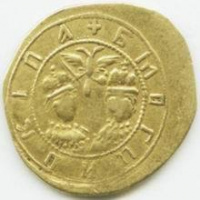
These coins were not currency and were not affected by the monetary reforms of Alexei Mikhailovich, even though some bore the same dates 1654 and 1655 as "yefimkas" (countermarked Western European thalers). They were intended exclusively for awarding. A significant portion was awarded to the deserving Cossacks of Bohdan Khmelnytsky, who, after a series of victories over the Poles, contributed to the unification of Left-bank Ukraine (from the left bank of the Dnieper eastward) with Russia. They are known in two types. On the first type, the tsar's eagle is placed on both the obverse and reverse, surrounded by the name and title of the ruling sovereign. The second type bears an eight-line inscription with the name and title of the tsar on the obverse, and the eagle is placed on the reverse. During the reign of Sophia, Russia waged wars with the Crimean Tatars in 1687 - 1689, and after the victorious Crimean campaign, there was a need for further minting of these ducats - chervonets to award the army. Again, various ducat denominations were produced, from small mintings to ten-ducats. They differed in appearance from the first two types. The obverse side features a double portrait of the Tsareviches Ivan and Peter, and the reverse features a portrait of the ruling Tsarevna Sophia, the older sister of the younger Tsareviches. Around the portraits are inscriptions that are incomprehensible to many collectors, expressed only by the initial letters of names and titles (due to printing difficulties with the Cyrillic alphabet, the following Russian inscriptions are written in Latin letters):
Obverse: B.M.V.G.C.I.K.I.A.P.A.
which means:
B(ozhiyu) M(ilostyu) V(elikie) G(osudari) Ts(ari) I K(nyazya) I(oann) A(lekseevich) P(etr) A(lekseevich)
Reverse: I.G.B.C.IK.S.A.V.V.IM.R.S.
I G(osudarynya) B(lagovernaya) Ts(arevna) I K(nyazhna) S(ofiya) A(lekseevna) V(seya) V(elikiya) I M(alyya) R(ossii) S(amoderzhtsy)
There are minor variations in the inscriptions, and on lower ducat denominations, there are no separators between the letters. All the described gold mintings, with the exception of Shuisky's gold kopecks and dengas, are well-executed in terms of engraving and minting quality. In the second half of the 19th century, their restrikes were also minted at the St. Petersburg Mint in very limited quantities. They can be easily distinguished from the original mintings by their excellent preservation and modern minting. They are also very rare.

